When working with epoxy, timing is everything. Whether you’re pouring a tabletop, sealing a bar top, or tackling a custom build, understanding epoxy cure time helps you plan your workflow, avoid sticky setbacks, and deliver professional results. Let’s break it down.

How long does epoxy resin take to cure?
Epoxy dry times are affected by temperature: it takes longer for resin to cure in cooler temperatures whereas warmer temperatures promote a faster cure. Sometimes a surface that still feels slightly soft or flexible hasn’t fully cured yet and just needs more time or a warmer environment.
Most epoxy resins cure in two stages:
-
1. Initial set (dry to the touch):
24 hours. At this point, you can sand and apply a second coat if needed.
-
2. Full cure (rock-hard finish):
7 days. This is when epoxy reaches its maximum strength and durability.
🔶 Pro Tip: Aim for a workspace temperature of 70–80°F (21-27°C) to ensure best results.
Can the cure time of epoxy be accelerated?
Yes, with the right approach.
Here are some tips on WHAT TO DO and what NOT to do to get resin to cure more quickly:
|
What To Do |
What NOT To Do |
|
Maintain a warm curing environment (75–85ºF or 24-30ºC) |
Do not add extra hardener thinking it will speed up curing - it won’t and will ruin the mix. |
|
Use a space heater or heat lamp nearby to gently increase ambient temperature. |
Do not substitute Industrial Clear’s hardener with another brand’s faster-curing hardener. |
|
Keep the temperature stable during the first 24 hours of curing to avoid surface imperfections. |
Do not add foreign agents or solvents to accelerate the cure. Industrial Clear is not designed for them. |
|
Allow resin to cure naturally for optimal clarity and durability. |
Do not rush the process at the expense of the resin’s appearance or structural integrity. |
Recommended Tools:
• A shop thermometer to monitor air temperature.
• A small space heater or heat lamp for consistent warmth.

🔶 Pro Tip: Avoid pouring in temperatures above 95°F (35°C). The heat may prompt an exothermic reaction causing the resin to get smoking hot, cure instantly and even crack.
What is the working time of epoxy resin?
Also called pot life, this is the window before epoxy thickens and becomes unworkable. Once the resin and hardener have been mixed, you have a working time of about 45 minutes to pour Industrial Clear over your project before it gets too thick to work with.

Epoxy resin is sensitive to mass and temperature and will start to cure much more quickly if left to sit in the mixing container. For this reason, we recommend pouring within 10 minutes of mixing to get the most out of your epoxy resin cure working time.
🔶 Pro Tip: Prepare your workspace and lay out your tools — mixing containers, spreaders, mixing sticks, propane torch — before mixing. Once the clock starts, you’ll be glad you’re ready to go.
Recommended Tools:
• A long mixing stick with a flat side for scraping the sides of the mixing container, or mixing drill with a paddle for big batches.
• Large graduated mixing containers with clear measurement markings.
• Notched spreaders for spreading.
• Nitrile Gloves to protect your hands. Epoxy is sticky.
• Paper Towels for quick and easy clean up.

Epoxy Not Drying?
If your epoxy hasn’t hardened after the expected cure time, these are the usual culprits:
Reason 1: Incorrect mixing ratio.
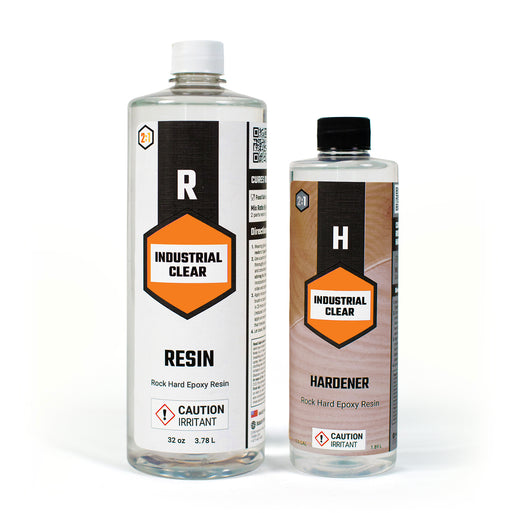
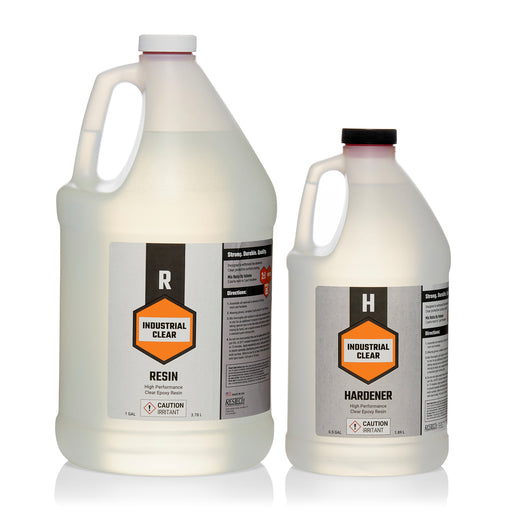
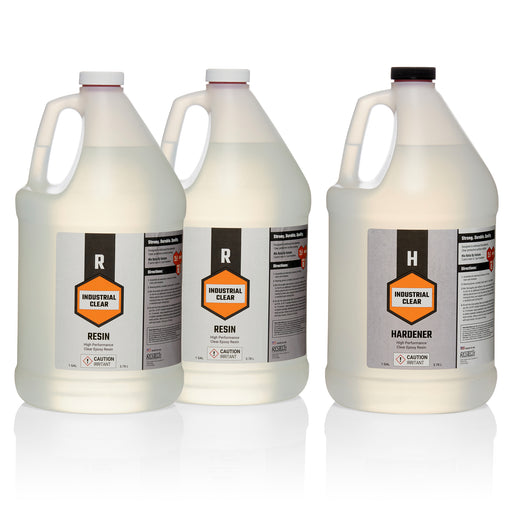
Industrial Clear needs an exact 2:1 ratio (resin: hardener), by volume. Too much resin or hardener = tacky mess.

To figure out exactly how much resin you need, visit Industrial Clear's online calculator.
Select either Rectangle or Circle, then enter your projects dimensions or diameter.
The calculator will tell you the exact amount of resin and hardener required, along with the correct size kit for your project.
🔶 PRO TIP: If you prefer to measure using a scale, you will need 100 parts resin: 54 parts hardener.

Reason 2: Incomplete Mixing
Even with the right ratio, unmixed epoxy won’t cure. Scrape the sides and bottom of the cup or mixing bucket. Mix slowly and thoroughly for at least 6-8 minutes to get the best results.
Additionally, if the resin was scraped out as it was poured from the mixing container, the unmixed product stuck to the sides will contaminate the mixture, resulting in soft, sticky spots on an otherwise cured surface.

Reason 3: Low temperature
If your workspace is under 70°F (21°C), expect delays. The ideal temperature for your workspace is between 70–80°F (21-27°C).
Anything cooler and it will take longer to cure, or could even remain tacky.

Reason 4: Thick pours
Deep layers generate excess heat, which can lead to uneven curing or cracks.
🔶 Pro Tip: For pours thicker than 1/8" (3 mm), work in layers. New layers can be poured every 4-6 hours, or after 24 hours with sanding. Don’t forget to use a torch every time you pour to pop bubbles.

Reason 5: Too much colorant
While Industrial Clear works with a wide range of colorants, but it's important not to exceed 6% of the total combined resin and hardener volume. Going beyond that may prevent the resin from curing properly.
A good approach is to start small. Add a little colorant at a time and build up gradually until the reach the depth and opacity you're looking for.
🔶 PRO TIP: For best results, use highly pigmented, non-water based colorants such as pigment paste, mica powder or a products specifically designed for epoxy resin. We recommend doing a small test batch first to make sure you're happy with the final color before committing to your full pour.

Knowing your epoxy cure time keeps your project on track and your results professional. Control your environment, prep your tools, and respect the working time to get that flawless, rock-hard finish.
Industrial Clear: Rock Hard Epoxy Resin.